More Information. Less Movement.

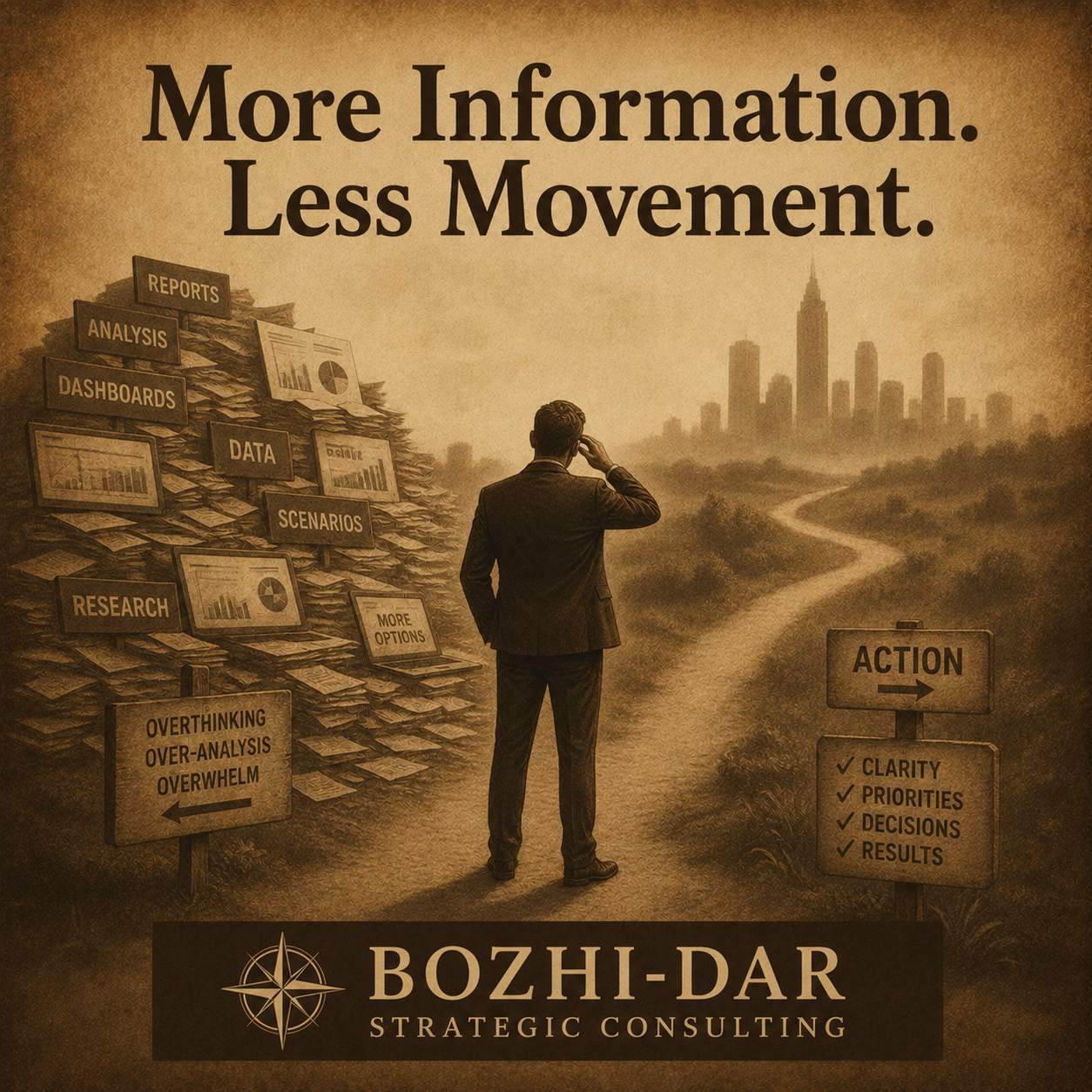
More Information. Less Movement.
We are entering a strange era.
For most of human history, information was expensive.
Finding the right answer took time.
Research took effort.
Analysis required specialists.
Insight was scarce.
Today, the opposite is true.
Need a SWOT analysis?
Done in seconds.
Need competitor research?
Done in minutes.
Need a market overview?
Done before your coffee gets cold.
Need a three-year strategic roadmap?
AI can draft one before the meeting even starts.
Information has never been cheaper.
And yet, something interesting is happening.
Many organizations are not moving faster.
They're moving slower.
More reports.
More dashboards.
More meetings.
More analysis.
More options.
More scenarios.
More information.
Less movement.
At first glance, this doesn't make sense.
If we know more than ever before, shouldn't decisions become easier?
Not necessarily.
Because information and action are not the same thing.
Information reduces uncertainty.
Action creates exposure.
And those are very different experiences.
It's comfortable to analyze.
It's comfortable to research.
It's comfortable to compare options.
It feels productive.
It feels responsible.
It feels safe.
Making a decision is different.
A decision creates consequences.
A decision creates accountability.
A decision can be wrong.
And that's why many organizations continue gathering information long after they already understand the problem.
The bottleneck has moved.
Ten years ago, the challenge was often:
"How do we figure this out?"
Today the challenge is more often:
"What are we actually willing to do about it?"
This is visible everywhere.
Teams spend months discussing improvements they already agree on.
Leaders request additional reports for decisions they already understand.
Projects stay in planning long after the direction is clear.
Not because information is missing.
Because commitment is.
The irony is that more information can sometimes create less action.
Every new report creates another perspective.
Every new analysis creates another possibility.
Every new scenario creates another reason to wait.
Eventually, organizations become trapped in what looks like progress.
But progress and movement are not the same thing.
Progress happens when reality changes.
Movement happens when decisions are implemented.
Neither happens during the twentieth review meeting.
The companies that move fastest are rarely the ones with the most information.
They are usually the ones with the clearest priorities.
They know enough.
Then they act.
AI is making analysis faster.
Research cheaper.
Insight more accessible.
Those are incredible advantages.
But they don't eliminate the need for leadership.
They don't eliminate the need for courage.
And they certainly don't eliminate the need for decisions.
The future will not be divided by who has access to information.
Almost everyone will.
The future will be divided by who is willing to act on it.
Information is abundant.
Insight is accelerating.
Action remains rare.
And that is where the real advantage still lives.

